Actors and Messages
This chapter covers the core building blocks: actors, state, messages, handlers, and endpoints.
Actors
An actor in murmer is a small server defined as a Rust struct with a set of handler methods, persisting state, and message types. You define an actor by implementing the Actor trait, then implementing Handler methods for each message type it can handle.
use murmer::prelude::*;

#[derive(Debug)]
struct ChatRoom;

struct ChatRoomState {
    room_name: String,
    messages: Vec<ChatEntry>,
}

impl Actor for ChatRoom {
    type State = ChatRoomState;
}
Key points:
- The actor struct itself is typically a zero-sized type (no fields). All mutable state lives in the associated
Statetype. - State is passed as
&mut Stateto every handler, keeping the actor struct itself lightweight and the state explicitly threaded. - Each actor runs inside a supervisor that manages its lifecycle, mailbox, and restart behavior.
Messages
A message is a type that can be sent to an actor. Every message defines a result type and can optionally be serializable for remote delivery.
There are two ways to define messages:
Auto-generated messages (recommended)
When using #[handlers] with #[handler], the macro generates message structs automatically from your method signatures:
#[handlers]
impl ChatRoom {
    #[handler]
    fn post_message(
        &mut self,
        _ctx: &ActorContext<Self>,
        state: &mut ChatRoomState,
        from: String,
        text: String,
    ) -> usize {
        state.messages.push(ChatEntry { from, text });
        state.messages.len()
    }

    #[handler]
    fn get_history(
        &mut self,
        _ctx: &ActorContext<Self>,
        state: &mut ChatRoomState,
    ) -> Vec<String> {
        state.messages.iter()
            .map(|e| format!("{}: {}", e.from, e.text))
            .collect()
    }
}
This generates PostMessage { pub from: String, pub text: String } and GetHistory unit struct, plus all the trait implementations and an extension trait ChatRoomExt on Endpoint<ChatRoom>.
Explicit messages
For messages shared across multiple actors, define them manually with #[derive(Message)]:
use murmer::Message;
use serde::{Serialize, Deserialize};

#[derive(Debug, Clone, Serialize, Deserialize, Message)]
#[message(result = Vec<String>, remote = "orchestrator::ListDir")]
struct ListDir {
    path: String,
}
Then reference it in a handler with the msg parameter name:
#[handlers]
impl StorageAgent {
    #[handler]
    fn list_dir(
        &mut self,
        _ctx: &ActorContext<Self>,
        state: &mut StorageState,
        msg: ListDir,
    ) -> Vec<String> {
        state.dirs.get(&msg.path).cloned().unwrap_or_default()
    }
}
The remote = "..." attribute is optional — omit it for local-only messages that don’t need wire serialization.
Async handlers
Handlers that need to await use async fn:
#[handlers]
impl MyActor {
    #[handler]
    async fn fetch_data(
        &mut self,
        ctx: &ActorContext<Self>,
        state: &mut MyState,
        url: String,
    ) -> Vec<u8> {
        some_async_call(&url).await
    }
}
This generates an AsyncHandler<FetchData> implementation instead of Handler<FetchData>.
Endpoints
Endpoints are opaque handles to actors used to send messages and receive responses. The Endpoint<A> type abstracts where the actor lives — whether local or remote — and handles serialization in the background.
// Start returns a typed endpoint
let counter = system.start("counter/main", Counter, CounterState { count: 0 });

// Send via auto-generated extension trait
let result = counter.increment(5).await.unwrap();

// Or send a message struct directly
let result = counter.send(Increment { amount: 5 }).await.unwrap();
Location transparency
The key design principle: Endpoint<A> hides whether the actor is local or remote.
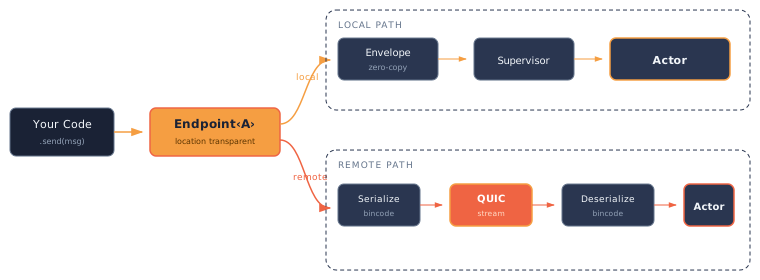
- Local actors use the envelope pattern — zero serialization cost, direct in-memory dispatch through a type-erased trait object.
- Remote actors serialize messages with bincode, send them over QUIC streams, and deserialize responses on return.
The caller’s code is identical in both cases:
let result = endpoint.send(Increment { amount: 5 }).await?;How endpoints work under the hood
Under the hood, an endpoint wraps a tokio channel that sends messages to the actor’s supervisor:
- Local endpoint: The channel connects directly to the actor’s supervisor (mpsc). Messages are dispatched as type-erased envelopes with zero serialization cost.
- Remote endpoint: The channel connects to a proxy supervisor that serializes the message in bincode format, sends it through a QUIC stream, awaits the response, deserializes it, and returns it to the caller.
Endpoints are lightweight and Clone — share them freely across tasks.
Actor watches
Erlang-style actor monitoring — get notified when a watched actor terminates:
impl Actor for Monitor {
    type State = MonitorState;

    fn on_actor_terminated(
        &mut self,
        state: &mut MonitorState,
        terminated: &ActorTerminated,
    ) {
        match &terminated.reason {
            TerminationReason::Panicked(msg) => {
                tracing::error!("{} panicked: {}", terminated.label, msg);
            }
            _ => {}
        }
    }
}

#[handlers]
impl Monitor {
    #[handler]
    fn watch_actor(
        &mut self,
        ctx: &ActorContext<Self>,
        _state: &mut MonitorState,
        label: String,
    ) {
        ctx.watch(&label);
    }
}
The ActorContext provides the watch() method, and termination notifications arrive via the on_actor_terminated callback on the Actor trait.