Supervision
Every actor in murmer runs inside a supervisor. The supervisor manages the actor’s lifecycle — starting it, processing its mailbox, and restarting it when things go wrong. This model is directly inspired by Erlang/OTP’s supervision trees, adapted for Rust’s ownership and type system.
How supervisors work
Each actor gets its own supervisor. The supervisor is responsible for:
- Starting the actor and registering it with the receptionist.
- Mailbox processing — ingesting messages and passing them to the actor’s handlers in order of arrival.
- Crash detection — catching panics and deciding what to do next based on the restart policy.
- Restarting the actor using a factory if the policy allows it.
- State notifications — informing the receptionist of state changes (started, stopped, dead, etc.).
- Context — providing the actor with access to the system, receptionist, and other actors via
ActorContext.
Supervisors are flat — there is no parent-child hierarchy between actors. Each actor is independent and can be stopped or restarted without affecting others.
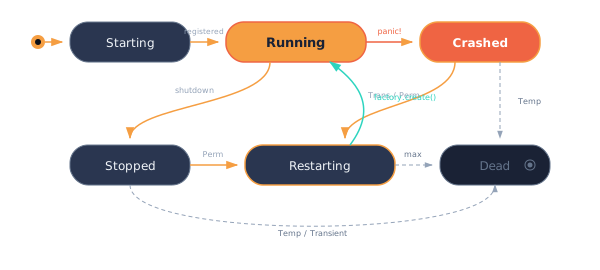
Actor lifecycle
The supervisor manages an actor through a well-defined set of states:
Restart policies
Actors can be started with restart policies that control behavior on failure:
| Policy | Restart on panic? | Restart on clean stop? |
|---|---|---|
Temporary | No | No |
Transient | Yes | No |
Permanent | Yes | Yes |
- Temporary — the actor runs once. If it panics or stops, it’s gone. This is the default.
- Transient — the actor restarts if it panics, but a clean shutdown is respected. Use this for actors that should survive crashes but can be intentionally stopped.
- Permanent — the actor always restarts, whether it panicked or stopped cleanly. Use this for critical services that must always be running.
Configuration
To use restart policies, you provide an ActorFactory (which knows how to create fresh instances) and a RestartConfig:
use murmer::{RestartPolicy, RestartConfig, BackoffConfig, ActorFactory};
use std::time::Duration;

struct MyFactory;
impl ActorFactory for MyFactory {
    type Actor = Counter;
    fn create(&mut self) -> (Counter, CounterState) {
        (Counter, CounterState { count: 0 })
    }
}

let endpoint = receptionist.start_with_config(
    "counter/resilient",
    MyFactory,
    RestartConfig {
        policy: RestartPolicy::Permanent,  // Always restart
        max_restarts: 5,                   // Max 5 restarts...
        window: Duration::from_secs(60),   // ...within 60 seconds
        backoff: BackoffConfig {
            initial: Duration::from_millis(100),
            max: Duration::from_secs(30),
            multiplier: 2.0,
        },
    },
);
Restart limits
The max_restarts and window fields prevent infinite restart loops. If the actor exceeds the restart limit within the time window, the supervisor gives up and the actor is permanently stopped. This prevents a persistent bug from consuming all your resources.
Exponential backoff
The BackoffConfig controls the delay between restarts:
initial— delay before the first restart attempt.max— maximum delay (the backoff caps here).multiplier— each subsequent restart delay is multiplied by this factor.
For example, with initial: 100ms, max: 30s, multiplier: 2.0, restarts happen at 100ms, 200ms, 400ms, 800ms, … up to 30s.
Actor factories
The ActorFactory trait gives the supervisor a way to create fresh actor instances for restarts:
trait ActorFactory {
    type Actor: Actor;
    fn create(&mut self) -> (Self::Actor, <Self::Actor as Actor>::State);
}
The factory is called each time the supervisor needs a new instance. It can carry its own state if needed — for example, incrementing a generation counter or loading configuration from disk.
Interaction with the receptionist
When a supervised actor restarts:
- The old actor instance is dropped.
- The supervisor creates a new instance via the factory.
- The new instance is registered with the receptionist under the same label.
- Any actors watching the old instance receive a termination notification, but the label remains routable.
This means endpoints held by other actors remain valid through restarts — messages sent during the brief restart window are queued in the supervisor’s mailbox and delivered to the new instance.
Deregistration on termination
When a supervisor exits, whatever the reason, a DeregisterGuard removes the
actor from the receptionist and fires any watches. That guard runs in Drop, so
in normal operation deregistration is instantaneous. There is no moment where an
actor has stopped serving messages but is still discoverable.
Real deployments are messier. An actor can accept its stop and then take time to drain a mailbox or tear down an external resource, staying registered but not serving for a while. Code that waits on deregistration has to tolerate that window, and the tolerance is hard to test when the window is zero-width by construction.
Receptionist::set_terminate_hook opens it:
receptionist.set_terminate_hook(Some(Arc::new(my_hook))); // None clears itThe hook is awaited between the supervisor exiting and the guard firing. While
it is pending, lookup still finds the actor, listings still include it, and its
watches have not fired. It returns a future rather than taking a duration, so
under simulation you build the delay from the runtime seam and the window runs
on virtual time, reproducible from the seed.
It is a fault-injection seam. Do not do real work in it. It runs on the supervisor’s task and holds the registry entry for as long as it stays pending, so a hook that never completes leaks the entry. It fires for every actor terminating on the node, including murmer’s internal ones, so a hook aimed at one actor has to filter on the label it is handed. It does not fire on the restart-limit-exceeded path, where the receptionist deregisters directly instead of through a supervisor exit.
See Extending Simulation for a worked example that holds one named actor in that state for five seconds of virtual time.
Watching actors
Any actor can monitor another actor for termination using ctx.watch(). When the watched actor terminates (for any reason), the watcher receives an ActorTerminated notification via on_actor_terminated.
impl Actor for Supervisor {
    type State = SupervisorState;

    fn on_actor_terminated(&mut self, state: &mut SupervisorState, event: &ActorTerminated) {
        tracing::warn!("Actor {} terminated: {:?}", event.label, event.reason);
    }
}

#[handlers]
impl Supervisor {
    #[handler]
    fn start_worker(&mut self, ctx: &ActorContext<Self>, state: &mut SupervisorState) {
        ctx.receptionist().start("worker/0", MyWorker, WorkerState::default());
        ctx.watch("worker/0");
    }
}
Watches are one-shot: they fire once when the watched actor terminates and are not re-armed.
Erlang semantics: If ctx.watch() is called for an actor that doesn’t exist, on_actor_terminated fires immediately. This avoids the race condition where the actor dies between the lookup and the watch.
Tagged watches
When a supervisor manages multiple children with different roles, parsing label strings in on_actor_terminated is fragile. Use ctx.watch_with_tag() to attach a role tag that is delivered alongside the termination notification:
fn start_children(&mut self, ctx: &ActorContext<Self>, state: &mut SupervisorState) {
    let r = ctx.receptionist();

    state.writer = Some(r.start("writer/0", WriterActor, WriterState::default()));
    ctx.watch_with_tag("writer/0", "writer");

    state.reader = Some(r.start("reader/0", ReaderActor, ReaderState::default()));
    ctx.watch_with_tag("reader/0", "reader");
}

fn on_actor_terminated(&mut self, state: &mut SupervisorState, event: &ActorTerminated) {
    match event.tag.as_deref() {
        Some("writer") => {
            tracing::error!("writer died — restarting");
            state.writer = None;
        }
        Some("reader") => {
            tracing::warn!("reader died — clearing slot");
            state.reader = None;
        }
        _ => {}
    }
}
Plain ctx.watch() delivers ActorTerminated with tag: None — fully backward compatible.
Scheduling
Actors can send delayed or periodic messages to themselves using the scheduling API. The returned ScheduleHandle auto-cancels when dropped.
schedule_once
Send a message to the actor after a delay:
fn handle(&self, ctx: &ActorContext<Self>, state: &mut MyState, _msg: StartTimeout) -> () {
    state.timeout = Some(ctx.schedule_once(Duration::from_secs(30), TimeoutExpired));
    // Drop state.timeout to cancel before it fires.
}
schedule_repeat
Send a message to the actor on a repeating interval:
fn on_start(&self, ctx: &ActorContext<Self>, state: &mut MyState) {
    state.heartbeat = Some(ctx.schedule_repeat(Duration::from_secs(60), Heartbeat));
}
The first tick fires after one full interval elapses (not immediately). Missed ticks are skipped — if the actor is slow, it receives one tick per interval boundary rather than a burst of catch-up ticks.
ScheduleHandle
ScheduleHandle is returned by both scheduling methods. Hold it in actor state to keep the schedule alive. Drop it (or call .cancel()) to stop the timer:
struct MyState {
    maintenance: Option<ScheduleHandle>, // Some = running, None = cancelled
}

// Cancel from a handler:
fn handle(&self, _ctx: &ActorContext<Self>, state: &mut MyState, _msg: StopMaintenance) -> () {
    state.maintenance = None; // drop cancels the timer
}
When the actor stops, all ScheduleHandles in its state are dropped and their timers are cancelled automatically.