Introduction
Built with AI. Murmer is built and maintained with the help of AI coding tools, primarily Claude. I drive the design and review every change, but a lot of the implementation, tests, and docs are written in collaboration with AI. I’d rather you know that going in.
Murmer is a distributed actor framework for Rust, built on tokio and QUIC.
It provides typed, location-transparent actors that communicate through message passing. Whether an actor lives in the same process or on a remote node across the network, you interact with it through the same Endpoint<A> API.
Why I built this
I’ve spent years working with Elixir and the BEAM VM, and the actor model there is something I’ve grown deeply fond of — the simplicity of processes, message passing, and supervision just works. When I looked at bringing that experience to Rust, I studied existing implementations like Actix, Telepathy, and Akka (on the JVM side). They’re impressive systems, but I kept running into the same friction: getting a basic actor up and running was complex, and adding remote communication across nodes was even more so.
Murmer is an experiment in answering a simple question: can you build a robust distributed actor system in Rust that’s actually simple to use?
The answer, it seems, is yes.
The design draws heavy inspiration from BEAM OTP’s supervision and process model, Akka’s clustering approach, and Apple’s Swift Distributed Actors for the typed, location-transparent endpoint API. The goal is to combine these ideas with Rust’s performance and safety guarantees — zero-cost local dispatch, compile-time message type checking, and automatic serialization over encrypted QUIC connections when actors span nodes.
Murmer in 1 minute
Install:
[dependencies]
murmer = "0.4"
serde = { version = "1", features = ["derive"] }
tokio = { version = "1", features = ["full"] }
Write an actor, send it messages:
use murmer::prelude::*;

// ① Define your actor — state lives separately
#[derive(Debug)]
struct Counter;
struct CounterState { count: i64 }

impl Actor for Counter {
    type State = CounterState;
}

// ② Handlers become the actor's API
#[handlers]
impl Counter {
    #[handler]
    fn increment(
        &mut self,
        _ctx: &ActorContext<Self>,
        state: &mut CounterState,
        amount: i64,
    ) -> i64 {
        state.count += amount;
        state.count
    }

    #[handler]
    fn get_count(
        &mut self,
        _ctx: &ActorContext<Self>,
        state: &mut CounterState,
    ) -> i64 {
        state.count
    }
}

#[tokio::main]
async fn main() {
    // ③ Create a local actor system
    let system = System::local();

    // ④ Start an actor — returns a typed Endpoint<Counter>
    let counter = system.start("counter/main", Counter, CounterState { count: 0 });

    // ⑤ Send messages via auto-generated extension methods
    let result = counter.increment(5).await.unwrap();
    println!("Count: {result}"); // → Count: 5

    // ⑥ Look up actors by label — works for local and remote
    let found = system.lookup::<Counter>("counter/main").unwrap();
    let count = found.get_count().await.unwrap();
    println!("Looked up: {count}"); // → Looked up: 5
}
cargo run
That’s it — a complete, working actor system. The rest of this page explains what’s happening under the hood. The Getting Started chapter goes deeper into each component.
What it gives you
- Send messages without caring where the actor lives.
counter.increment(5)(line ⑤) works identically whether the actor is local or on a remote node — theEndpoint<A>API abstracts the difference away. - Test distributed systems from a single process.
System::local()(line ③) runs everything in-memory. Swap toSystem::clustered()when you’re ready for real networking — your actor code stays identical. - Define actors with minimal boilerplate. The
#[handlers]macro (line ②) auto-generates message structs (Increment,GetCount), dispatch tables, serialization, and the extension methods you call on line ⑤. - Get networking and encryption handled for you. QUIC transport with automatic TLS, SWIM-based cluster membership, and mDNS discovery — all configured, not hand-rolled.
- Supervise actors like OTP. Restart policies (Temporary, Transient, Permanent) with configurable limits and exponential backoff keep your system running through failures.
- Orchestrate applications across a cluster. The
appmodule adds placement strategies, leader election, and crash recovery — so you can declare what should run and where, and the framework handles the rest.
What’s happening: line by line
① Actor + State — Counter is a zero-sized struct. All mutable state lives in CounterState, passed as &mut to every handler. This keeps the actor lightweight and the state threading explicit.
② #[handlers] — The macro reads your method signatures and generates:
- Message structs —
Increment { pub amount: i64 }andGetCount(unit struct) Handler<Increment>andHandler<GetCount>trait implementationsRemoteDispatch— a wire-format dispatch table so remote nodes know how to route messages to the right handlerCounterExt— an extension trait onEndpoint<Counter>that gives you.increment(amount)and.get_count()methods
③ System::local() — Creates the actor runtime and boots the Receptionist — the internal actor registry that tracks all actors by label and type.
④ system.start(...) — Wraps Counter in a Supervisor that manages its lifecycle, mailbox, and restart behavior. Registers it with the Receptionist under the label "counter/main". Returns an Endpoint<Counter> — your typed send handle.
⑤ counter.increment(5) — The extension method constructs an Increment { amount: 5 } message and sends it through the Endpoint. Since this is a local actor, the message is dispatched as a zero-copy envelope through the Supervisor’s mailbox to the handler. The result comes back through a oneshot channel.
⑥ system.lookup(...) — Queries the Receptionist for an actor of type Counter at label "counter/main". Returns the same Endpoint<Counter>. In a clustered system, this could return a proxy endpoint that transparently serializes messages over QUIC to a remote node.
Core concepts
| Concept | In the example | Purpose |
|---|---|---|
| Actor | Counter + CounterState | Stateful message processor. Actor has no fields — state lives separately. |
| Message | Generated Increment, GetCount | Defines a request and its response type. |
| RemoteMessage | Generated by #[handlers] | A message that can cross the wire (serializable + TYPE_ID). |
| Endpoint | counter from system.start(...) | Opaque send handle. Abstracts local vs remote — callers never know which. |
| Receptionist | Powers system.lookup(...) | Type-erased actor registry. Start, lookup, and subscribe to actors. |
| Router | Not shown — see Discovery | Distributes messages across a pool of endpoints (round-robin, broadcast). |
| Listing | Not shown — see Discovery | Async stream of endpoints matching a ReceptionKey. |
Architecture
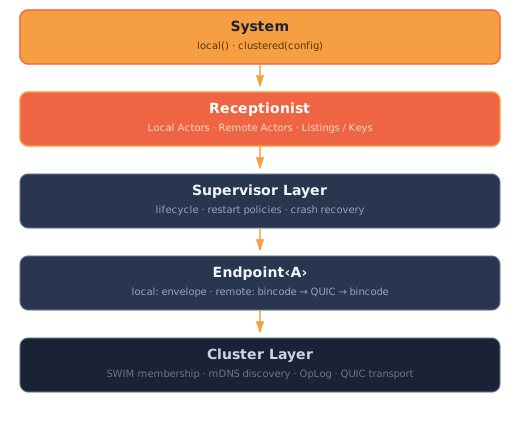
Every layer in this diagram is touched by the example code:
- System — created at line ③, runs the entire runtime
- Receptionist — populated at line ④ (
start), queried at line ⑥ (lookup) - Supervisor Layer — wraps
Counterat line ④, manages its mailbox, would handle restarts if configured - Endpoint‹A› — returned at line ④, used at line ⑤ to send messages; local dispatch here, but swap to
System::clustered()and the same endpoint transparently routes over QUIC - Cluster Layer — not active in
System::local(), but requires zero code changes to enable (see Clustering)
Key design decisions
- Endpoint<A> is the only API — callers never know if an actor is local or remote.
- Receptionist is non-generic — stores type-erased entries internally, uses
TypeIdguards for safe downcasts at lookup time. - Supervisors are flat — each actor has its own supervisor, no parent-child hierarchy.
- Labels are paths —
"cache/user","worker/0","thumbnail/processor/3". Hierarchical naming for organizational clarity. - Fail-fast networking — if a QUIC stream fails, all pending responses error immediately instead of hanging.
From primitives to applications
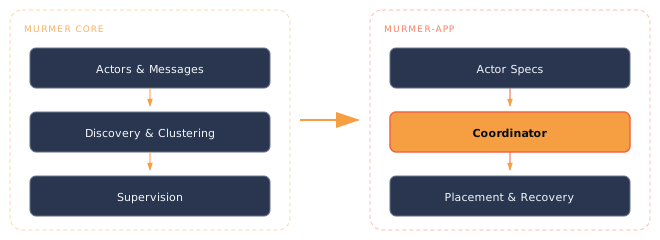
Murmer works at two levels:
The core (Actors, Discovery, Supervision, Clustering) gives you the building blocks — everything you saw in the example above. You can build complete services with just these primitives.
The application layer (Application Orchestration) builds on top of the core to manage real, running applications across a cluster. You declare what actors should run, where they should be placed (with constraints like “must have GPU” or “must be a Worker node”), and what happens when a node fails — and the Coordinator handles placement, spawning, and crash recovery automatically.
Other libraries to consider
Murmer is still v0 and an experiment. For anything real, you should probably consider using one of these instead. They inspired Murmer and most of them are far more mature:
- Erlang/Elixir OTP — the actor model and supervision tree that started it all for me. If you can run on the BEAM, OTP is decades of battle-tested production experience.
- Apple Swift Distributed Actors — the typed, location-transparent endpoint design that shaped Murmer’s API. Worth reading even if you’re not writing Swift.
- Actix — the most established actor framework in Rust. Mature, fast, and great for in-process actors.
- ractor — a newer Rust actor library inspired by Erlang, with a clustering story of its own. Well worth a look if you’re comparing options.
Learn more
- Getting Started — deeper walkthrough of each component
- API Reference on docs.rs
- Source on GitHub